
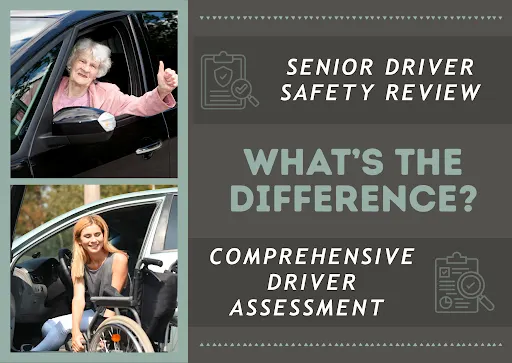
As we age, changes in vision, reaction time, strength, and overall mobility can begin to impact driving. For many individuals and families, the question isn’t whether independence matters—it’s how to maintain it safely.
That’s where driver evaluation services come in. At Driving to Independence, two common options are the Senior Driver Safety Review and the Comprehensive Driver Assessment. While both are designed to support safe driving, they serve different purposes and are appropriate for different situations.
Understanding the difference can help you determine which option may be the right fit.
What Is a Senior Driver Safety Review?
A Senior Driver Safety Review is a shorter evaluation designed for older adults who are currently driving but may benefit from a general safety check.
This type of review looks at how age-related changes may be affecting driving ability, such as:
- Slower reaction time
- Reduced flexibility or strength
- Difficulty with attention or multitasking
The goal is not to retrain the driver, but to assess current driving habits and provide feedback.
Importantly, a Senior Driver Safety Review is a non-medical evaluation, meaning the driver must not have a medical diagnosis or condition that could affect driving.
When a Senior Driver Safety Review Is Appropriate
This option may be a good fit when:
- The individual is still actively driving
- Family members want reassurance about a loved one’s driving
- The driver has not experienced a recent injury or major medical change
- The goal is monitoring and guidance, not training
In many cases, the outcome may include recommendations such as adjusting driving habits, avoiding certain conditions (like nighttime driving), or making small changes to improve safety.
What Is a Comprehensive Driver Assessment?
A Comprehensive Driver Assessment is a more in-depth evaluation that looks at the full range of skills required for safe driving.
This type of assessment is typically completed by a Certified Driver Rehabilitation Specialist and includes:
- A clinical evaluation of physical, cognitive, and visual abilities
- An assessment of reaction time, coordination, and decision-making
- An on-road evaluation to observe real driving performance
- Recommendations for adaptive equipment, if needed
- Training or next steps based on the results
Driver rehabilitation programs are designed to help individuals regain or develop the skills needed for safe driving, following a medical event or diagnosis.
When a Comprehensive Driver Assessment Is Appropriate
This option is recommended when:
- There has been a recent injury, illness, or medical diagnosis (such as stroke, brain injury, spinal cord injury, novice drivers with autism or a neurological condition)
- The individual is returning to driving after time away
- There are significant concerns about safety
- Adaptive equipment may be needed
- The driver requires training, not just evaluation
In these cases, the goal goes beyond observation—it’s about determining whether driving is safe, what supports are needed, and how to move forward.
Key Differences at a Glance
While both services support safe driving, the primary difference comes down to depth and purpose.
- Senior Driver Safety Review
- Shorter, focused on a general review of skills
- Designed for currently active, senior drivers
- Identifies age-related changes
- Provides general safety feedback
- Comprehensive Driver Assessment
- More in-depth and structured
- Includes clinical and on-road evaluation
- Addresses medical or functional changes
- May lead to training or adaptive equipment recommendations
Why the Right Evaluation Matters
Choosing the right type of assessment ensures that drivers receive the level of support they need—no more, no less.
For some individuals, a simple safety review provides reassurance and helpful guidance. For others, a more comprehensive evaluation is essential to safely return to driving or adapt to new challenges.
Driver rehabilitation specialists play a key role in this process by evaluating not just whether someone can drive, but how they can drive safely and confidently based on their unique abilities.
Taking the Next Step
If you or a loved one are unsure which type of evaluation is appropriate, starting with a conversation can help clarify the best path forward. Our client care coordinator can provide details for your specific situation.
At Driving to Independence, both the Senior Driver Safety Review and Comprehensive Driver Assessment are designed to support safe, independent mobility while taking each individual’s needs into account.
Understanding the difference is the first step toward making an informed decision—and reaching out is the next step toward continuing to drive with confidence and safety in mind.