
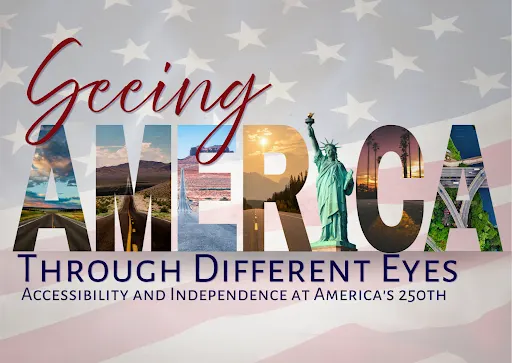
As the United States celebrates its 250th anniversary, many Americans are reflecting on where we’ve been and where we’re headed. At the same time, major international events are bringing visitors from around the world to our cities, stadiums, airports, parks, and communities. For many travelers, this is an opportunity to experience America for the first time.
It also presents an interesting question:
What would a visitor notice about accessibility in the United States?
Most Americans rarely stop to think about the curb cut at the end of a sidewalk, the automatic door at a grocery store, or the accessible seating section at a stadium. These features have become so common that they often fade into the background. Yet for millions of people, they are not conveniences. They are essential tools that make participation possible.
As we celebrate the legacy of the Americans with Disabilities Act (ADA), it is worth stepping back and looking at accessibility through fresh eyes—not just as Americans, but even as travelers exploring a new place.
A Law That Changed Everyday Life
When the ADA was signed into law in 1990, it represented a significant shift in how the United States approached accessibility and inclusion. More than thirty-five years later, its impact can be seen in communities across the country.
Accessible parking spaces, curb ramps, elevators, public accommodations, transportation improvements, and workplace protections have become part of daily life. While challenges remain, the ADA helped establish an important principle: people with disabilities should have the opportunity to participate fully in society.
That idea has influenced far more than building design. It has shaped conversations about independence, employment, recreation, travel, and community life.
Today, many accessibility features are so integrated into our surroundings that visitors may be surprised by how frequently they appear.
Accessibility Looks Different Around the World
While accessibility has become an expected part of many American experiences, that is not always the case everywhere else.
In parts of Europe, visitors may encounter beautiful historic city centers that were built centuries before accessibility was considered. Narrow streets, uneven cobblestones, and historic buildings can create challenges despite efforts to improve access.
In some countries, public transportation systems may be more extensive than those in the United States, making travel easier for certain individuals. In others, accessibility laws and accommodations may be less developed, leaving people to navigate barriers that Americans might not expect.
Even within the United States, accessibility experiences can vary. A newly developed downtown district may offer wide sidewalks, accessible transit options, and modern facilities, while a historic area may present unique challenges due to its age and design.
These differences do not necessarily reflect a lack of effort. Often, they highlight the complex balance between history, infrastructure, resources, and evolving accessibility standards.
What Travelers Notice
When most people travel, they notice landmarks, local food, and cultural traditions.
Travelers with disabilities often notice something else.
They notice whether a hotel room truly meets their needs. They notice if public transportation is easy to navigate. They notice whether a stadium, museum, or attraction allows them to participate comfortably and independently.
Accessibility can influence every part of a trip, from booking accommodations to navigating unfamiliar streets.
For some travelers, the question is not simply, “What should we see while we’re here?”
It is, “Will we be able to experience it?”
That perspective can reveal something important: accessibility is not just about physical structures. It is about opportunity.
What Accessibility Says About a Community
One of the most powerful things accessibility communicates is that everyone belongs.
A visitor may never know who advocated for an accessible trail, who pushed for improved transit access, or who helped design a more inclusive community event. But they experience the results.
When people can move through a community with confidence, participate in activities, and engage with others without unnecessary barriers, it sends a message that their presence matters.
Accessibility is not only about compliance. It is about hospitality.
It is a way communities welcome residents and visitors alike and create opportunities for people of different abilities to experience life together.
Independence Opens the Door to Exploration
As conversations about accessibility continue to evolve around the world, one truth remains constant: independence matters.
The ability to travel, visit family, attend events, explore new places, and participate in community life often begins with mobility.
For many individuals, driving provides that connection. It transforms opportunities that might otherwise feel out of reach into possibilities that can be pursued with confidence.
Whether someone is traveling across town or across the country, the ability to get where they want to go safely and independently can have a profound impact on quality of life.
Looking Forward
As America celebrates 250 years and welcomes visitors from around the globe, accessibility offers an opportunity to view our communities from a different perspective.
It reminds us that progress is not measured solely by roads, buildings, or technology. It is also measured by how well people are able to participate in the life of their communities.
The ADA’s legacy can be seen in countless everyday moments: a family enjoying a day at a museum, a traveler exploring a new city, a sports fan attending a game, or an individual maintaining the freedom to drive and remain connected to the people and places they love.
At Driving to Independence, we believe mobility plays an important role in that story. Through driver evaluations, adaptive driving solutions, and personalized support, we help individuals explore pathways to greater independence so they can continue participating in the experiences that matter most.
Because whether you’re welcoming visitors from around the world or exploring your own community, accessibility helps make the journey possible.